
Thirty years of doing this, written down. What size pole you actually need, how deep the footing has to be, how to get the pole in the ground properly, and the two things everybody rings us about.
What pole you need comes down to what you are trying to do with it, and your budget. Just about every flagpole flies a flag equally well, so the real questions are how big and how much. After that it is the wind in your area, and whether the flag is likely to be interfered with.
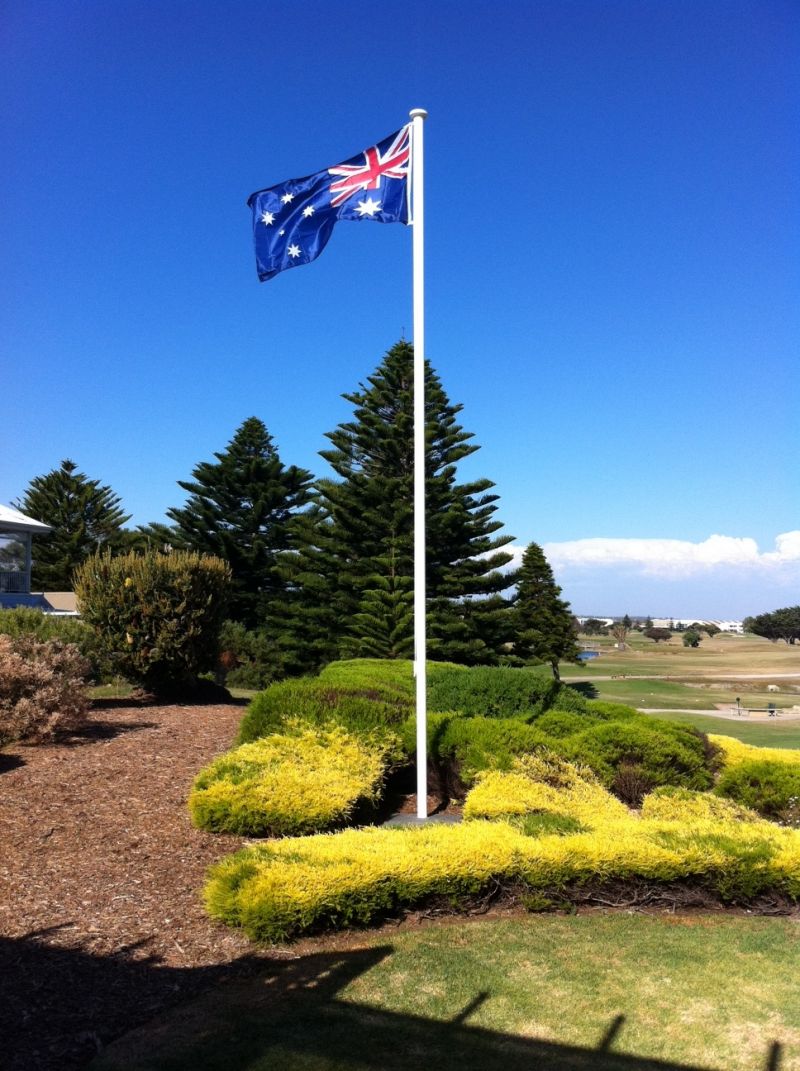
If you live in an average Australian house and you want to fly the flag to show your allegiance to your country or your footy club, a 6m pole will usually do the job, and an untapered one at that, because it is more economical than a tapered pole.
If you are on fifty acres with a four storey house on top of a hill, a 6m pole will look lost and something more substantial is justified.
Council approval is required in Australia for any flagpole over 10m tall, even if it is flying a national flag, and that applies to any nation, not just Australia.
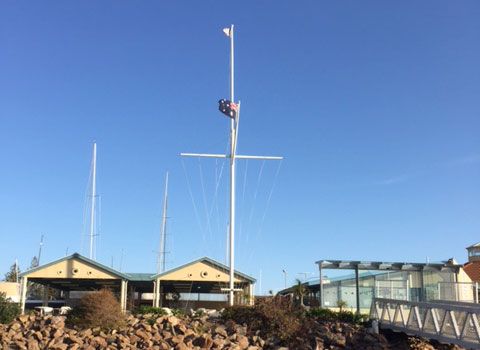
If the flags and poles are doing a job as signage, you want either one large pole that makes a landmark of itself, or a group of smaller poles set out in a cluster or a line reasonably close together.
8m is usually the practical limit for this. Anything taller starts to get lost among power lines and the general streetscape, well above the eye line of passing traffic.
There is no right or wrong answer here. If you are unsure, look at the flagpoles around town, and when you see one that looks right, find out how tall it is. You can attach a tape measure to the halyard rope and pull it up the pole.
A good trick: print a photo of your house, draw a flagpole on it where you want it and at a size that looks right, then scale the height off the photo. That is your answer.
Installing a Federation flagpole is not difficult or expensive, but it pays to get it right. If you can use a shovel and a spirit level, you can install your flagpole.
Put the pole where it will do the most good. A flagpole tucked away in a corner or behind trees will not have much impact, and a pole in a prominent position lifts the look of a property considerably. With multiple poles on a commercial site, grouping them maximises the impact of the poles and whatever the flags are saying.
Keep the pole away from overhead power lines. Remember that trees grow, and a flag catching on a branch will not last long. Do not put a pole so close to a building that the flag touches the structure.
Power lines, phone lines, fibre optic cable, irrigation, drainage and plumbing can all be underground and will ruin your day if you hit one. Look up and live. Dial before you dig.
The table below gives the recommended footing depth for common pole and goal post heights. These are calculated for average soil and represent a minimum acceptable footing. For loose sandy soils or exposed sites, increase the footing.
| Pole height | Urban site depth | Exposed site depth |
|---|---|---|
| 6m | 600mm | 700mm |
| 7.5m | 600mm | 700mm |
| 9m | 700mm | 800mm |
| 12m | 800mm | 900mm |
If in doubt, a good rule of thumb is a footing depth equal to 10 percent of the pole height. A 350mm diameter post hole is enough up to a 12m flagpole. Avoid a site where the soil is constantly waterlogged, as the footings can move over time.
With ground spigots or ground sleeves, rapid set concrete is strong enough and speeds the job up. With hold down bolts, do not use rapid set. Use normal instant concrete, or 25 MPa ready mix if you are installing a number of poles.
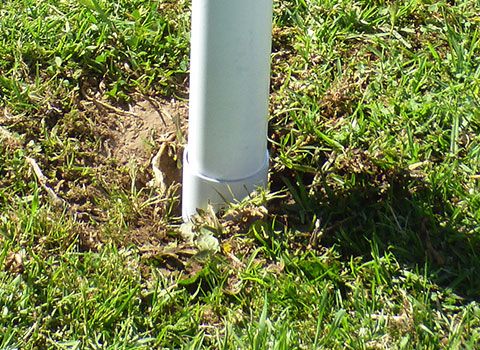
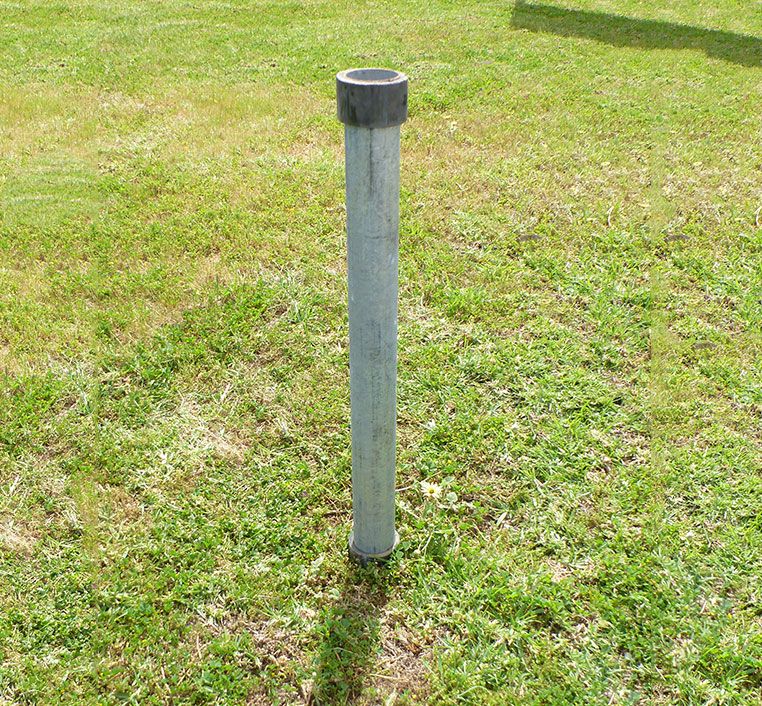
Dig or bore the post hole to the depth appropriate for your pole height and site. Place the pole, with the ground sleeve if you are using one, in the hole and have someone hold it plumb while you pour the concrete.
Plumb the pole as you pour, because you may not be able to adjust it once the concrete is in. The bottom of the aluminium should finish about 10 to 20mm above the finished height of the concrete, and the concrete should finish above ground level so water drains away and the pole does not corrode. Let the concrete cure for the recommended time before flying a flag.
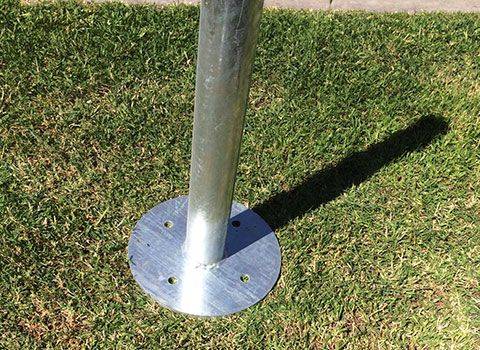
First assemble the hold down bolts and template and check they match the flange base on the bottom of the pole. There should be one nut and washer below the template and two above, on each bolt.
Dig or bore the hole to suit. You may need to enlarge it to take the bolts, which should sit no closer than 50mm to the edge of the hole. Use a string line and string level if you are installing multiple poles, and put your formwork in now if the pole is going on a plinth.
Mix and pour the concrete, then push the bolts and template in so the bottom of the template is level with the concrete. Wrap PVC tape around the threads to keep concrete splash off them, and use a small spirit level to get the template and the tops of the bolts level. Finish the concrete just above ground level.
Once cured, strip the formwork, remove the template and screw on the lower levelling nuts and washers. The very bottom set of nuts stays buried in the concrete, leave them. Level the bottom nuts and flat washers before the flange base goes on. With someone pushing down on the baseplate, walk the pole upright, place it on the bolts and immediately fit the flat washer, spring washer and top nuts to stabilise it.
After plumbing the pole, fill the void between the baseplate and the concrete with non shrink grout. It stops the lower nuts vibrating loose, makes the base look better, keeps the bolts loaded vertically as they are designed to be, and spreads the baseplate loads properly.
Flagpoles flex and vibrate in normal use, and in the first week that can loosen the top nuts. Check them seven days after erection and tighten if needed.
The two things people ring us about most, and both are fixable yourself.
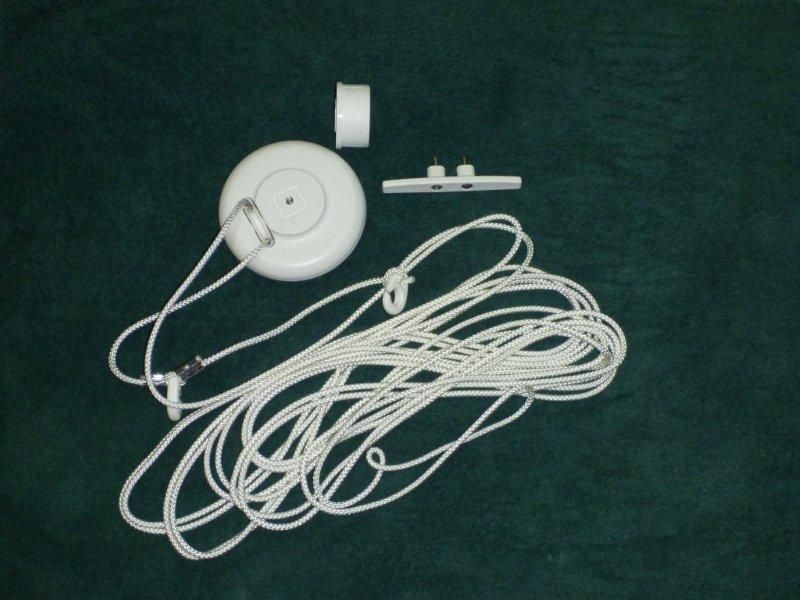
Sooner or later everyone loses the halyard to the top of the pole, or a flag clip breaks and leaves a short length of rope hanging up there. You can call us out to fix it, but that takes time and it costs, so it is worth a go yourself first.
Poles up to 9m can usually be lowered to the ground easily and the rope recovered down there. Poles over 9m can be lowered too, it is just a bit more work. The process is the reverse of putting the pole up.
Most poles are at the shorter end of the scale, and the halyard can be recovered with an extendable pool pole and a snapper sized fish hook. Tape the hook to the tip of the pole, extend it to the height of the flagpole and go fishing for the end of the rope or the flag clip. Wear your sunglasses, they help.
A flag does not have to be halfway down the pole to be at half mast. Anything other than full hoist can be read as half mast, and the generally accepted position is one to two flag widths down from full hoist.
When raising the flag from the ground it should go all the way to full height first, then be lowered to the half mast position. At the end of the day it goes back up to full height before it comes down.

Follow the instructions above and you should not strike trouble. If you do, call us on 0400 552 663 or send an enquiry and we will talk you through it and work out a solution. We want your flagpole to go up properly as much as you do.
Common questions
For an average Australian house, a 6m pole will usually do the job, and an untapered one at that because it is more economical. If you want the pole to make a statement, go with 8m or taller. In a high wind area go with a 6m heavy duty Garden Master, or an 8m or 10m pole.
Council approval is required in Australia for any flagpole over 10 metres tall, even if it is flying a national flag, and that applies to any nation, not just Australia. Under 10 metres you generally do not need it, but check with your council.
For an urban site, 600mm for a 6m or 7.5m pole, 700mm for a 9m pole and 800mm for a 12m pole. On an exposed site add 100mm to each. A good rule of thumb is a footing depth equal to 10 percent of the pole height, and a 350mm diameter post hole is enough up to a 12m flagpole.
Yes. If you can use a shovel and a spirit level you can install your flagpole. Dig the hole to the right depth, plumb the pole as you pour the concrete, and let it cure before you fly a flag. Take care with hold down bolts, where rapid set concrete is not strong enough.
Poles up to 9m can usually be lowered to the ground and the rope recovered there. Otherwise tape a snapper sized fish hook to the tip of an extendable pool pole, extend it to the height of the flagpole and fish for the end of the rope or the flag clip.
A flag does not have to be halfway down the pole. Anything other than full hoist reads as half mast, and the accepted position is one to two flag widths down from full hoist. Raise the flag to full height first, then lower it to the half mast position.
Either way, get in touch. We will confirm the right size, the right base and what the freight will cost before you commit to anything.
